


GMP-Ready Recombinant Human IL-7 Protein

IL-7
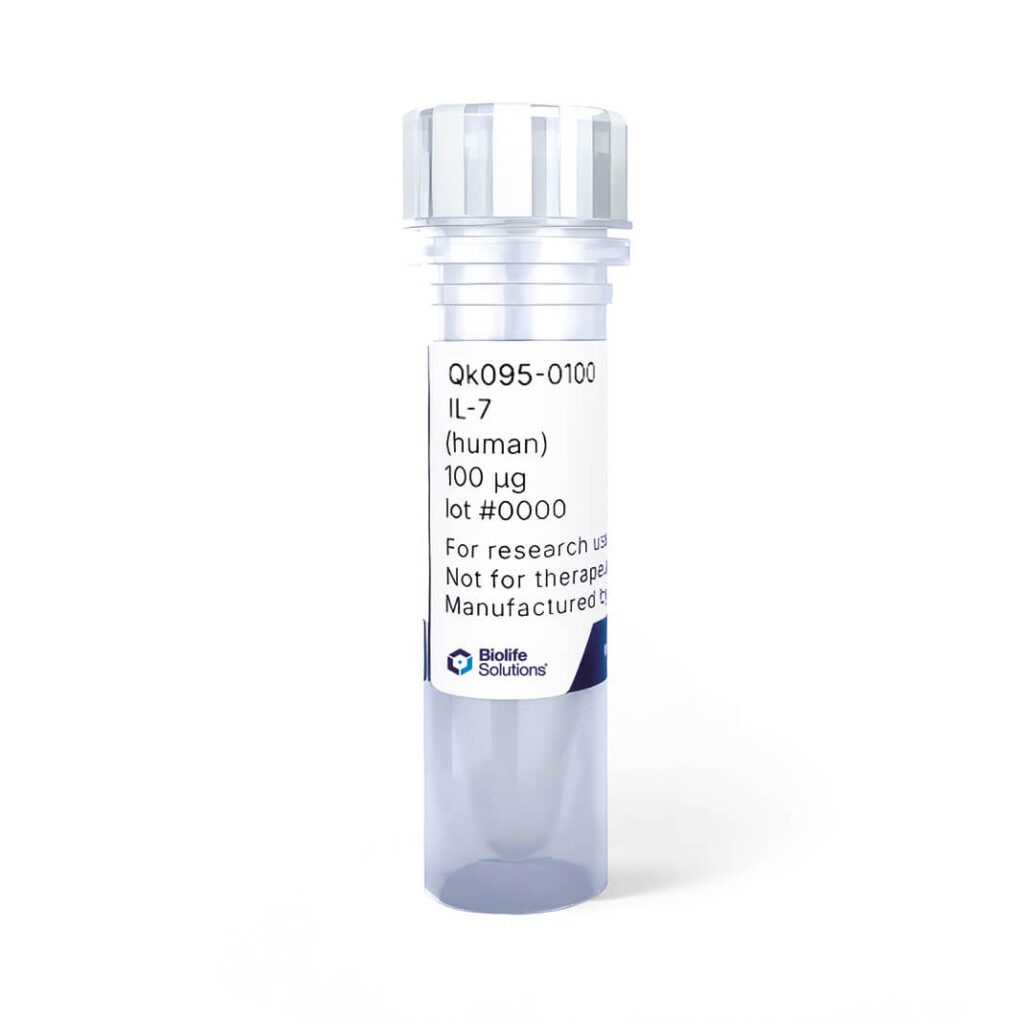
Support T-cell expansion and activation with highly pure, animal origin-free IL-7 complete with regulatory documentation
Human Interleukin-7 (IL-7) is a key cytokine in immune regulation. Essential for early lymphoid progenitor development and homeostasis, IL-7 supports maintenance of naïve and memory T-cell populations. Through its effects on lymphocyte maintenance and function, IL-7 is widely used in immunology and regenerative medicine applications.
The IL-7 manufacturing process has been optimized to produce a highly bioactive protein with excellent lot-to-lot consistency for enhanced experimental reproducibility.
- Immune cell therapy expansion
- CAR-T cell therapy manufacturing
- Expressed in E. coli
- Animal origin-free (AOF) and carrier protein-free (CF)
- Manufactured under a certified ISO 9001:2015 Quality Management System
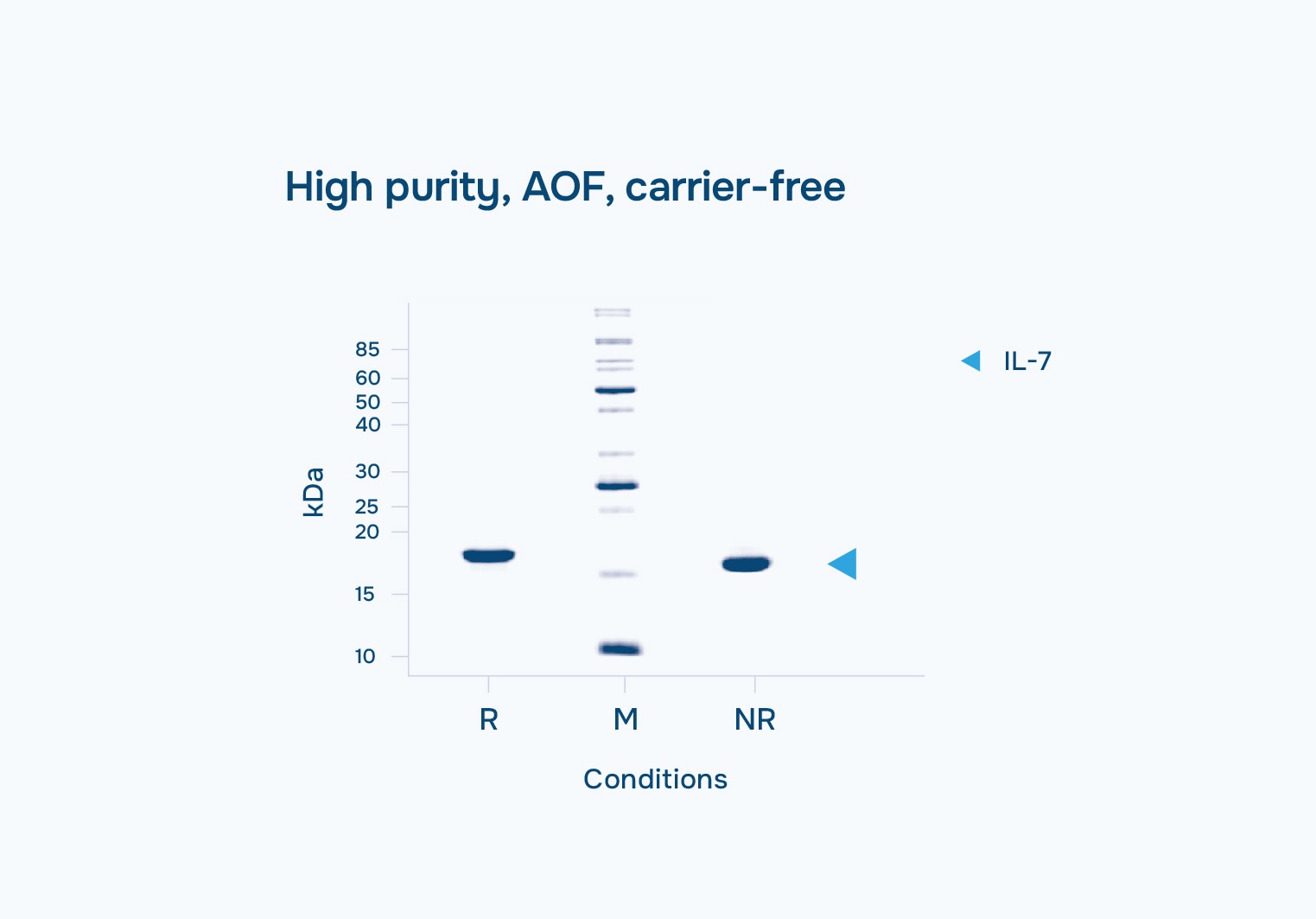
- 17.5 kDa monomer
- >98%, by SDS-PAGE quantitative densitometry
- Lyophilized from acetonitrile, TFA
- Reconstitute in sterile-filtered water at >50 μg/mL, add carrier protein if desired, prepare single use aliquots and store frozen at -20°C (short-term) or -80°C (long-term).
- Qk095-0025 = 25 µg
- Qk095-0050 = 50 µg
- Qk095-0100 = 100 µg
- Qk095-0500 = 500 µg
- Qk095-CTG-0500 = 500 µg
Please download IL-7 resources here:
Applications

NAIVE T Cell

IL-7
Survival &
Homeostasis
MEMORY T Cell
Common pairing: IL-7 + IL-15.

High Purity
Recombinant IL-7 migrates as a major band at approximately 17.5 kDa (monomer) in reduced (R) and non-reduced (NR) conditions. No contaminating protein bands are present. The purified recombinant protein (3 µg) was resolved using 15% w/v SDS-PAGE in reduced (+β-mercaptoethanol, R) and non-reduced (NR) conditions and stained with Coomassie Brilliant Blue R250. Data from Qk095 lot #204669.
Bioactivity
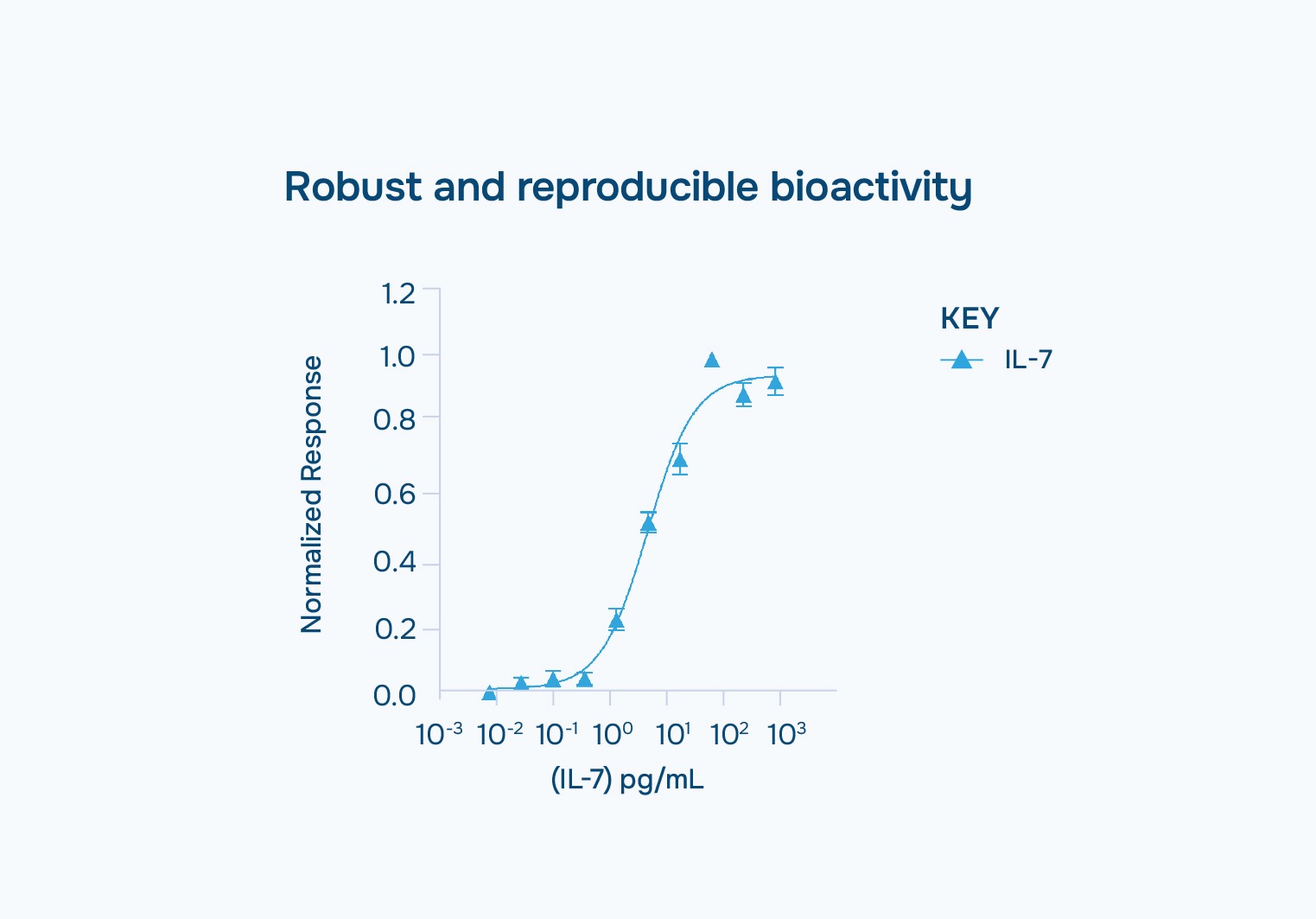
Recombinant IL-7 was more bioactive than the WHO (NIBSC) standard IL-7. IL-7 activity was determined using a SRE luciferase reporter assay in transiently transfected HEK293 cells co-transfected with IL-7Rα and IL-7Rγ. Transfected cells were treated in triplicate with a serial dilution of IL-7 for 3 hours. Firefly activity was measured and normalized to the control Renilla luciferase activity. Qk095 #204669 EC50 = 1.20 ng/ml (69 pM). WHO (NIBSC) standard EC50 = 3.40 ng/ml.

How can we help you?
Sales inquiries
Product Background
IL-7 is a non-glycosylated protein with a molecular weight of about 17.5 kDa. It features four alpha-helices that facilitate its interaction with the IL-7 receptor (IL-7R), a heterodimer consisting of the IL-7Rα chain (CD127) and the common gamma chain (γc, CD132). This binding initiates signaling through the JAK-STAT pathway, particularly involving STAT5 phosphorylation, which promotes T cell survival, proliferation, and differentiation [1].
IL-7 is essential for the survival and homeostasis of T cells, supporting the development of thymocytes in the thymus and maintaining naive and memory T cells in the periphery, thus ensuring effective immune surveillance and long-term memory [2]. IL-7 influences B cell development and plays a role, though less prominently, in the development of natural killer (NK) cells [2].
IL-7 is extensively studied for its potential in cancer immunotherapy, where it enhances immune responses, particularly in promoting T cell recovery following chemotherapy or radiation, and in combination with checkpoint inhibitors [4]. In HIV and other chronic infections, IL-7 is explored for its ability to restore immune function by increasing CD4+ T cell counts and reducing immune exhaustion, potentially improving the effectiveness of existing therapies [3]. IL-7 also plays a key role in bone marrow transplantation, where it accelerates T cell recovery, reduces immune vulnerability, and is studied for its potential to mitigate graft-versus-host disease (GVHD) [4, 5].
In autoimmune diseases like multiple sclerosis and rheumatoid arthritis, IL-7 is a target for controlling autoreactive T cell survival and proliferation, offering new therapeutic approaches [5]. IL-7 is investigated as a vaccine adjuvant, particularly in vaccines requiring strong T cell responses, and in regenerative medicine, where its role in expanding T cells and hematopoietic stem cells is harnessed to enhance the efficacy of immune system regeneration therapies [4-6].
[1] McElroy, C.A., Holland, P.J., Zhao, P., et al. Structural reorganization of the interleukin-7 signaling complex. Proc. Natl Acad. Sci. USA 109, 2503–2508 (2012).
[2] Barata, J.T., Silva, A., Brandão, J.G., et al. IL-7 and IL-7R in immune homeostasis and cancer. Trends Immunol. 40, 580–594 (2019).
[3] Seddon, B., Tomlinson, P. & Zamoyska, R. Interleukin 7 and T cell receptor signals regulate homeostasis of CD4 memory cells. Nat. Immunol. 4, 680-686 (2003).
[4] Schluns, K.S., Kieper, W.C., Jameson, S.C. & Lefrançois, L. Interleukin-7 mediates the homeostasis of naïve and memory CD8 T cells in vivo. Nat. Immunol. 1, 426-432 (2000).
[4] Sportès, C. et al. Administration of rhIL-7 in humans increases in vivo TCR repertoire diversity by preferential expansion of naive T cell subsets. J. Exp. Med. 205, 1701-1714 (2008).
[5] Conlon, K.C. et al. IL-15 and IL-7 receptor alpha-dependent expansion of dual TCR T lymphocytes in patients with refractory malignancy receiving IL-15. J. Clin. Invest. 125, 94-110 (2015).
Frequently asked questions
Disclaimer
For use in manufacturing of cellular or gene therapy products.
Not intended for in vivo applications.